The people’s choice
Last night we had a sellout crowd for the 1956 sci-fi classic The Invasion of the Body Snatchers, including a surprising number of kids. We talked to a few of them after the movie, and they reported that it was a little scary, but not too much. Marshall and I were actually surprised at how good it was.
Next Wednesday we’ll have a very different kind of classic, Gone with the Wind. It’s an unusually long movie, nearly 4 hours, so there will be nothing ahead of it. The film will start right at 7:00, with a brief intro at 6:55. There will be an 8-minute intermission.
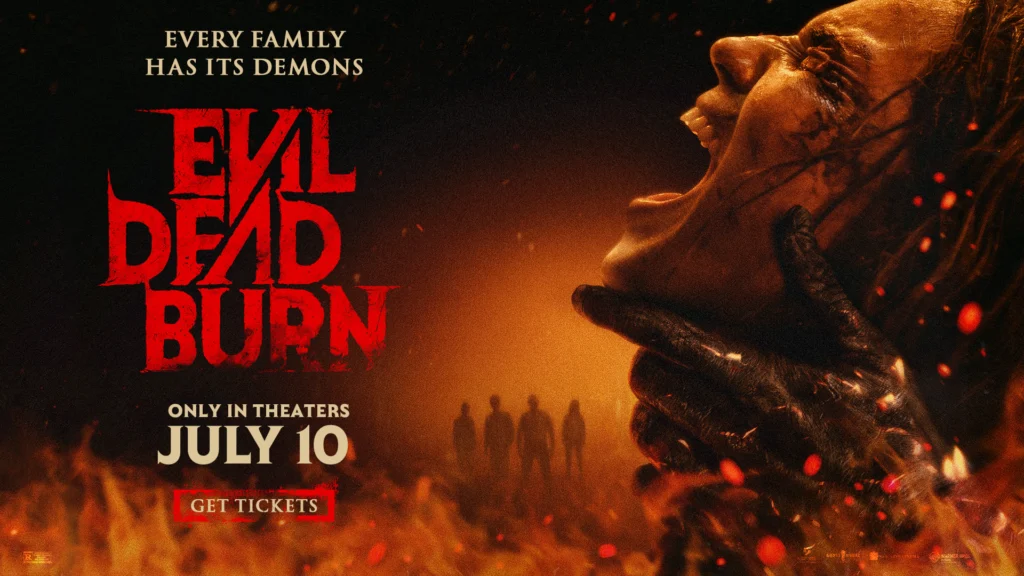
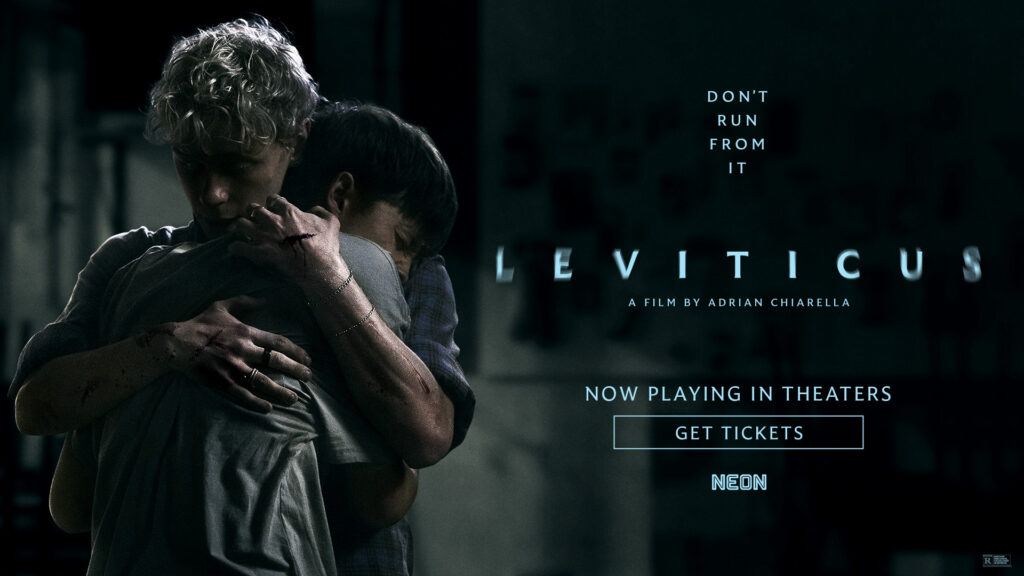
Lest you think we’ve gone all classic, we most certainly have not. New to our screens this weekend are Evil Dead Burn and Leviticus. Jessa will explain in her commentary below why we show so many horror films.
We’re holding over Minions and Monsters and Toy Story 5. Night Light this week is Tank Girl.
OUR SCREENS
• • • NOW PLAYING • • •


Evil Dead Burn
By Jessa Keddy
The Evil Dead franchise is, in fact, not dead. From the original film in 1981 to this new installment in 2026, the dead won’t quit. This American horror franchise began with director Sam Raimi, who remains a beloved cinematic icon. Evil Dead (1981) launched Raimi’s career by pioneering a new type of horror – slapstick, frenetic, gore-heavy horror that relies on practical effects. The micro-budgeted cult classic is still considered a cornerstone of modern day horror.
Enter Evil Dead Burn. While this isn’t directly related to the 1981 film, it is a standalone sequel to 2013’s Evil Dead and 2023′s Evil Dead Rise, making it the sixth installment in the Evil Dead film series. While Evil Dead Burn is produced by Sam Raimi, it is directed by up-and-coming French filmmaker Sébastien Vaniček. Vaniček entered the horror scene with several short films under his belt, and his feature length film Vermin, retitled to Infested, boasted a world premiere at the 80th Venice International Film Festival. Sam Raimi was so impressed with the directorial debut that he hired Vaniček for his new film. Early reviews from die-hard fans are praising it, saying we ain’t ready for this feral, rabid animal. If gore isn’t your thing, stay away from this one!

Leviticus
By Jessa Keddy
“Cinema Salem, why do you keep getting horror movies?”
Simple. Because people show up to them. And request them. Ad nauseam (pun intended). Leviticus is no different. In fact, this film was one of the most requested films of the year, just behind Iron Lung (web campaign trend) and of course, Practical Magic 2 (duh). So we rearranged our schedule to get Leviticus onto our screens. For the people.
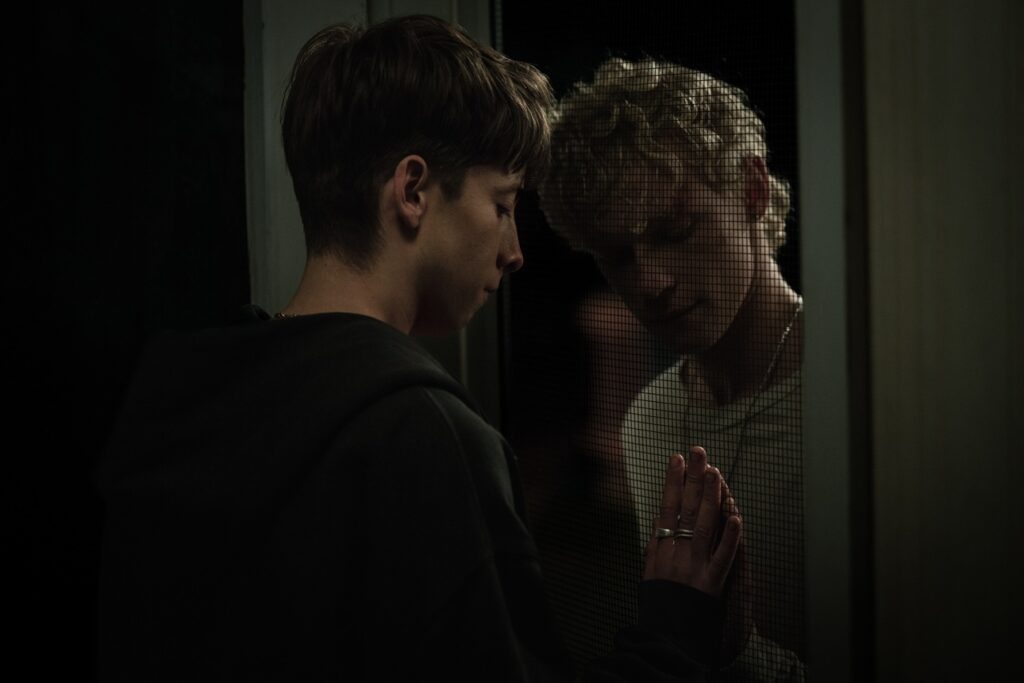
Currently sitting at 92% on Rotten Tomatoes with 144 reviews, this horror film out of Australia checks several boxes – supernatural, coming-of-age, romance, queer. It is the first feature from Australian director Adrian Chiarella, and we think he might as well have designed it specifically for Salem audiences. The RT critics’ consensus states: “Merging an emotionally-involving queer relationship with its clever monster concept, Leviticus executes its intriguing hook with eerie aplomb.” More praise comes for the two romantic leads, Joe Bird and Stacy Clausen, who showcase raw, authentic chemistry. Some are saying this is the best horror movie of 2026. We had great turnouts for Obsession and Backrooms earlier this year; we hope this late-comer gets the same.
Wednesday Classics
Gone with the Wind
By Elaine Gerdine
Gone with the Wind is challenging to talk about, and this article is too long because there is so much to say. The movie is the source of one of cinema’s most famous lines: “Frankly, my dear, I don’t give a damn.” It it praised for its scope and pageantry. It is acclaimed for its many legendary performances. And it is criticized for its romanticized, sanitized depiction of the antebellum South and sympathetic view of slavery.
Gone with the Wind was the first film ever to receive 10 Academy Awards, a record that would stand for decades. Two of the awards were for technical achievement in cinematography and visual innovation. One of the innovative visual techniques was the actual torching of massive old Hollywood sets to show the burning of Atlanta. The cinematographers wanted a realistic conflagration, so they created one.
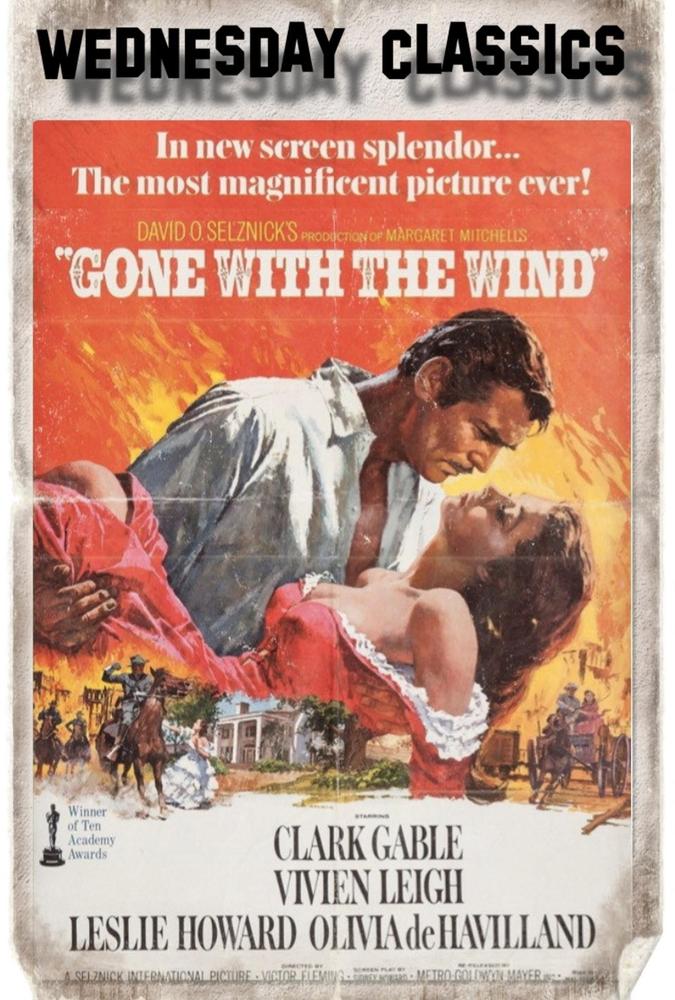
Gone with the Wind won Academy Awards for Best Picture (beating The Wizard of Oz), Best Director, Best Screenplay, Best Cinematography and a few others. Beyond the Oscar-winning performances by Vivian Leigh and Hattie McDaniel, there was Clark Gable’s legendary portrayal of Rhett Butler. The scale of the film was almost unprecedented, with sprawling, meticulously detailed sets designed to immerse the audience in the scenes. The film’s scale was matched by its hype. The New York Times critic wrote that he had almost been looking forward to being disappointed by the movie, but it had lived up to its PR. Gone with the Wind still has the largest box-office receipts of any film in history, when numbers are adjusted for inflation.
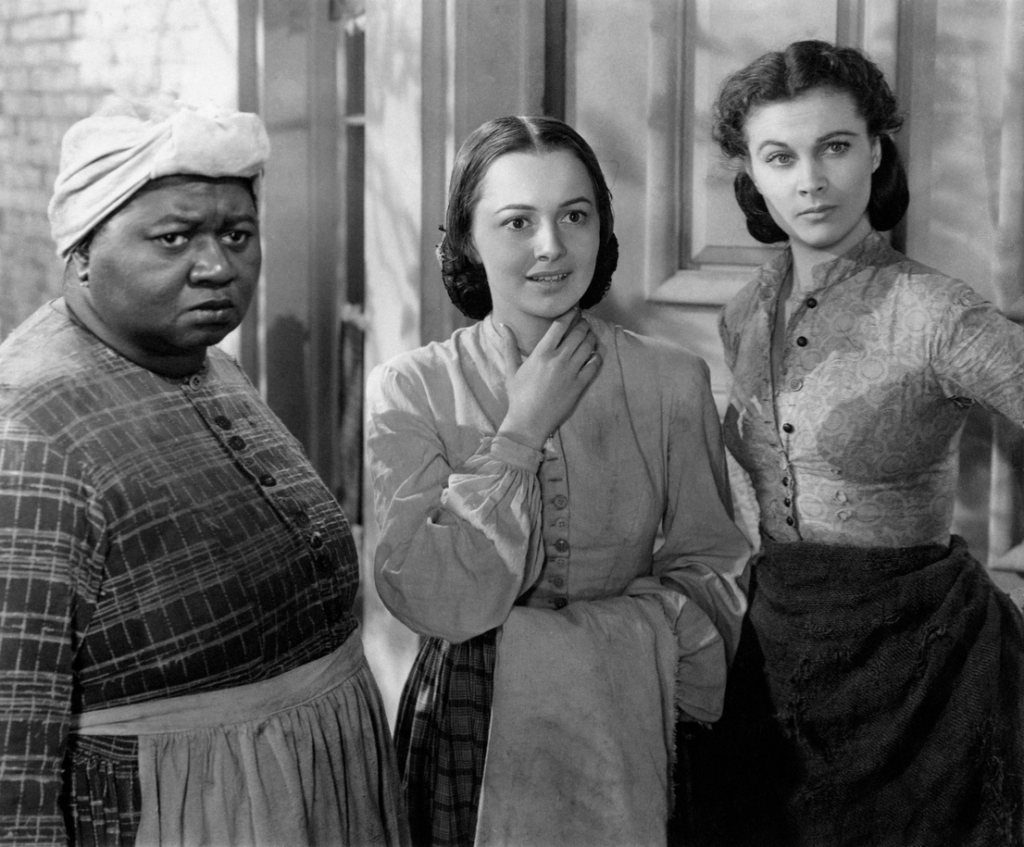
Hattie McDaniel, Olivia de Havilland and Vivian Leigh in a publicity photo for Gone with the Wind
Still, controversy swirled around the film from the start. Its portrayal of the antebellum South is something that today’s white nationalists would likely endorse. White plantation families lived beautiful, gracious lives, made possible by the service of Blacks who were subservient, loyal, well-fed, happy, and probably only marginally capable of living without the protection of their masters. Gone with the Wind‘s Black characters are demeaning caricatures, making it all the more impressive that Hattie McDaniels could act her way to an Oscar-winning performance as Mammy, Scarlett O’Hara’s nanny of sorts. In 1940, McDaniel became the first Black person to receive an Academy Award when she won Best Supporting Actress.
Racism in the South when Gone with the Wind was made was taken for granted, but it was never true that all southerners were racists. Furthermore, racism was not absent from other parts of the country. The treatment of Hattie McDaniel in 1939 and 1940 is a perfect illustration of the ambiguity. She was not allowd to attend her film’s Atlanta premiere in 1939 because of Georgia’s segregation laws. But it wasn’t just Georgia. There was a strict no-Blacks policy at the Ambassador Hotel and its Cocoanut Grove Restaurant in LA, where McDaniel received her Oscar. She was admitted to the venue as a “favor” but had to sit at a segregated table in the back of the room.
Here the story becomes personal for me, because my mother loved Gone with the Wind, and she probably saw the movie in the same theater where it premiered. She had been born into the family of a wealthy Georgia industrialist (whose wealth disappeared a few years later; another story). The family home in the most fashionable part of Atlanta always had Black servants. Everyone accepted this as normal — because it was. My father had similar attitudes. His grandfather had owned a plantation in Mississippi. To his dying day, he insisted that his family were “good to their slaves.” As absurd as that idea may seem to us now, I’ve seen family letters written just after the Civil War, and even a slave narrative, that attest to that very thing. We are all fish unable to see the water we swim in.
While both my parents had affection for their Old South legacies, they also were creatures of their own times. My mother would have been aware of the treatment of Hattie McDaniel in 1939 Atlanta. The insult was hard to deny. And it may have helped nudge her toward a place where she could raise a little girl in south Georgia in the 1950s (me), who at about age 7 had to ask why some people didn’t think Black and white children should go to school together. I was honestly baffled.
Both my parents came to understand that their own feelings about race were not what they wished them to be, but you can’t just wish away feelings. I didn’t know how hard they worked not to transmit their feelings to the children until I was an adult. My mother finally talked about how shocking it was when I invited a Black girl from my junior high school to a party. She told me it was the first time a Black person had been in her home, other than servants. She was as gracious to that girl as she always was to everyone else, and it looked effortless to me.
In many ways the South has changed since the 1950s, and in some ways it has not. But we know that people can change. My mother changed. I appreciate the work it must have taken. And I will always have a soft spot for Gone with the Wind, with all its flaws. As I stated in the beginning, there’s a lot to say about this movie.
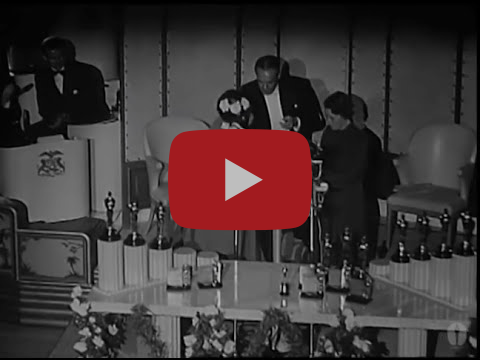
Watch this video of Hattie McDaniel’s acceptance speech at the 12th Academy Awards.

FIRST RUN

SPECIALTY

That’s all for now. Happy trails till next time.
~~~ Elaine, Jessa and Shanna